When Strep Changes Everything: Understanding PANS and PANDAS
One day, your child seems completely like themselves. Then suddenly, something changes.
Tics appear seemingly out of nowhere. OCD-like behaviors begin taking over their day. Anxiety, rage, emotional outbursts, or intense separation fears show up quickly. Maybe sleep changes. School becomes harder. Sensory sensitivities suddenly feel impossible to manage.
You’ve been to the pediatrician. Maybe you’ve seen a neurologist, therapist, or psychiatrist. You may have heard words like Tourette syndrome, ADHD, OCD, or anxiety.
But as a parent, you keep coming back to the same thought:
This happened so fast. What changed?
For some children, a sudden and dramatic change in behavior or neurological function following an illness may lead their healthcare team to investigate conditions known as PANS or PANDAS.
At Inspire Life Chiropractic, we believe understanding the whole picture matters. That includes the immune system, a child’s history and stress load, and an often-overlooked piece of the puzzle: how well their nervous system is regulating and adapting.
What Are PANS and PANDAS?
PANDAS stands for Pediatric Autoimmune Neuropsychiatric Disorders Associated with Streptococcal Infections.
PANS, or Pediatric Acute-onset Neuropsychiatric Syndrome, describes a broader pattern of sudden-onset neuropsychiatric symptoms that may be associated with different infectious, inflammatory, or other triggers.
Children experiencing PANS or PANDAS may develop symptoms very suddenly, including:
OCD-like behaviors such as checking, counting, repetitive behaviors, or intense fears
Motor tics such as blinking, facial movements, shoulder shrugging, or head movements
Vocal tics such as throat clearing, grunting, or repeated sounds
Increased anxiety or separation anxiety
Sudden emotional outbursts or changes in mood
New or heightened sensory sensitivities
Changes in sleep
Changes in handwriting or school performance
Developmental or behavioral regression
Changes in eating or toileting habits
What can make this experience especially frightening for families is how quickly everything can change.
Parents often describe feeling as though they woke up with a different child.
Why Can an Illness Affect One Child So Differently?
Not every child who gets strep or another infection develops PANS or PANDAS.
That’s why we believe it is important to look beyond the trigger itself and ask another question:
What was this child’s ability to adapt to stress before the illness occurred?
At ILC, we often describe accumulated stress as a child’s “Perfect Storm.”
Every child’s story is different, but their overall stress load can include factors such as pregnancy and birth experiences, repeated illnesses, physical stress, emotional stress, sleep challenges, nutrition, environmental factors, and other demands placed on a developing nervous system.
None of these factors alone means a child will develop PANS or PANDAS.
Instead, they help us understand an important concept: children do not experience stress in isolation.
Stress can stack.
And when a child’s nervous system is already having difficulty shifting between “go” and “rest,” another major stressor may be harder for their body to adapt to.
That is why we pay close attention to signs of nervous system dysregulation and dysautonomia that may have been present long before the sudden change occurred.
Maybe your child was already:
A difficult sleeper
Easily overwhelmed
Highly sensitive to sounds, textures, or transitions
Frequently constipated or struggling with digestion
Always “on the go”
Anxious or unable to settle
Experiencing frequent meltdowns
Having difficulty recovering after stressful events
Sometimes those earlier signs help us understand the bigger neurological picture.
Why Families Can Feel Like They’re Chasing Symptoms
Families navigating PANS or PANDAS often have multiple professionals involved in their child’s care, and appropriately so.
Depending on the individual child, medical treatment may involve evaluation for infection, medications, behavioral or psychological support, immune-focused care, nutrition, or other therapies.
These approaches can each play an important role.
But families often tell us that they still feel like there is a missing piece.
They may be working on the immune system.
They may be working on behaviors.
They may be supporting nutrition.
They may be seeing therapists and specialists.
Yet no one has stopped to ask:
How is this child’s nervous system actually functioning?
That is the piece we focus on at Inspire Life Chiropractic.
Looking at the Nervous System Differently
The nervous system is your child’s communication and adaptation system.
It is constantly receiving information from inside and outside the body and deciding how to respond.
Is it safe to relax?
Do we need to stay alert?
Can we digest?
Can we sleep?
Can we focus?
Can we transition from excitement back to calm?
A healthy nervous system needs to be able to move between activation and relaxation appropriately.
When a child becomes stuck in a pattern of chronic stress or sympathetic “fight-or-flight” activation, everyday demands can become much harder for them to process.
This does not mean nervous system dysregulation causes PANS or PANDAS.
It means that when we are supporting a child who is already dealing with a significant immune, neurological, or emotional challenge, we believe their ability to regulate and adapt deserves attention too.
How INSiGHT Scans Help Us See the Bigger Picture
One of the most important parts of care at Inspire Life Chiropractic is that we don’t want to guess about how a child’s nervous system is functioning.
We measure it.
Our Neurological INSiGHT Scans give us objective information about patterns of stress and regulation within the nervous system.
Depending on the child, this may include:
Heart Rate Variability (HRV): Helps us understand patterns within autonomic nervous system regulation and adaptability.
Surface Electromyography (sEMG): Measures patterns of muscle tension and energy along the spine.
Thermography: Looks at patterns associated with autonomic regulation along the spine.
Together, these scans help Dr. Gina better understand how a child’s nervous system may be handling stress and where patterns of neurological interference may be present.
This gives us a much more individualized starting point than simply looking at a diagnosis or list of symptoms.
Because two children can have the same diagnosis and have very different nervous systems.
Where Neurologically-Focused Chiropractic Fits In
Neurologically-Focused Chiropractic Care is not intended to diagnose, treat, or cure PANS or PANDAS.
It also is not meant to replace your child’s pediatrician, neurologist, therapist, psychiatrist, immunologist, or other healthcare providers.
Instead, chiropractic care can be one piece of a comprehensive approach focused on supporting nervous system function.
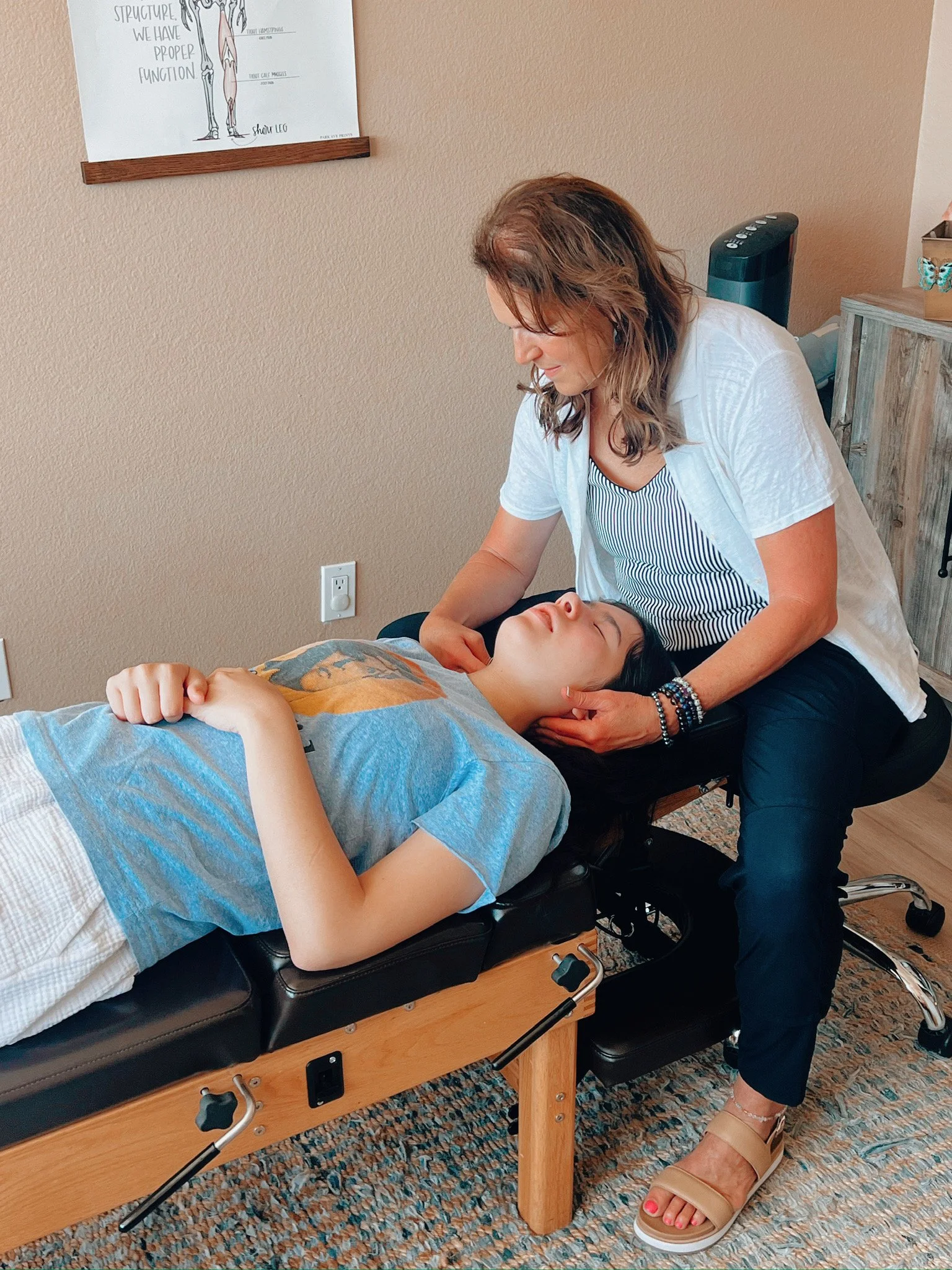
At ILC, Dr. Gina uses gentle, specific chiropractic adjustments based on each child’s history, examination, and neurological scan findings.
Our goal is not to chase individual symptoms.
Our focus is helping reduce neurological interference and supporting the nervous system’s ability to regulate, adapt, and respond to stress more effectively.
For children whose systems have been operating in overdrive for a long time, building greater neurological adaptability can be an important foundational piece of their overall wellness plan.
Caleb’s Story
Every child’s journey is different, but stories from other families can help parents see why looking at the nervous system may be worth considering.
In the middle of fourth grade, Caleb’s family watched their once-lively child begin struggling with major motor tics, mood changes, difficulty focusing, and challenges at school.
PANDAS was part of his medical picture, and his family pursued care through multiple healthcare professionals.
Eventually, they also chose to explore Neurologically-Focused Chiropractic Care as another piece of Caleb’s support system.
His chiropractic care plan was individualized around his neurological findings and focused on supporting nervous system regulation.
Over time, his family reported meaningful changes in his tics, mood, school performance, and ability to connect socially.
Caleb’s experience is his story, not a promise of results for another child. Every child’s health history, nervous system, medical needs, and response to care are different.
But stories like his remind us why looking at the whole child matters.
Your Child Is More Than Their Diagnosis
When your child changes suddenly, it is natural to want answers.
And when you’ve already seen multiple specialists, tried different approaches, and still feel like you are missing something, it can be exhausting.
At Inspire Life Chiropractic, we don’t believe you have to choose between medical care, therapy, nutrition, and nervous system support.
There can be room for all of it.
Our role is to look closely at the neurological piece of your child’s story and ask:
How much stress is their nervous system carrying?
How well are they adapting?
Are they able to shift out of “fight-or-flight” and into the “rest, regulate, and restore” side of their nervous system?
And what can we do to support that foundation?
If your child is navigating PANS, PANDAS, sudden-onset tics, OCD-like behaviors, anxiety, sensory challenges, or other signs of nervous system dysregulation, Neurological INSiGHT Scans can be a great place to start.
Reach out to Inspire Life Chiropractic in El Cajon, CA to schedule a nervous system assessment with Dr. Gina and learn more about what your child’s scans may be telling us.
Your child is more than a diagnosis.
Sometimes the next step isn’t another label. It’s getting a clearer picture of what their nervous system needs.