Why “More Salt and Slow Standing” May Not Be Enough for POTS
If your teen has been diagnosed with POTS, or Postural Orthostatic Tachycardia Syndrome, you already know how quickly it can change everyday life.
One day, they’re active, thriving, playing sports, keeping up with school, and spending time with friends. Then suddenly, standing up can send their heart racing. Getting through a school day feels impossible. Dizziness, migraines, fatigue, and brain fog can make even simple tasks feel overwhelming.
And after finally getting a diagnosis, many families are given recommendations like:
“Increase salt and fluids.”
“Wear compression garments.”
“Stand up more slowly.”
“Give it time.”
Those strategies can absolutely be helpful parts of POTS management. But when your child is missing school, stepping away from sports, sleeping through the day, or becoming increasingly anxious and isolated, it makes sense to wonder:
Is there another piece of the puzzle we should be looking at?
At Inspire Life Chiropractic, one of the areas we pay close attention to is the autonomic nervous system, because POTS is a form of dysautonomia. Understanding how that system is functioning can give families another valuable lens through which to understand what their child is experiencing.
Tommi’s Story
Tommi was a wildly active, athletic 17-year-old. She rode horses, cheered, earned A’s and B’s, and had her whole life ahead of her.
Then everything changed.
Her mom described extreme fatigue that kept Tommi in bed for much of the day, migraines and brain fog that made schoolwork incredibly difficult, along with tachycardia, low blood pressure, chest discomfort, insomnia, anxiety, and depression.
At her lowest point, even walking to the bathroom could be incredibly difficult because of fainting episodes. Much of her junior year was consumed by her health struggles.
Her family pursued the typical avenues of POTS care and continued searching for additional ways to support her.
Eventually, that search led them to neurologically focused chiropractic care as one part of her overall journey.
Over time, Tommi and her family reported significant improvements. She returned to cheering and riding horses and eventually headed to college on scholarship, with plans to become a chiropractor herself.
Tommi’s experience is her own, and every person with POTS has a different health history and response to care. But her story highlights something we believe is important:
When someone is struggling with dysautonomia, it makes sense to look closely at the nervous system.
POTS and the Autonomic Nervous System
POTS isn’t simply about having a fast heartbeat.
It is a form of dysautonomia, meaning the autonomic nervous system isn’t regulating certain automatic functions of the body as effectively as it should.
The autonomic nervous system helps coordinate things you never have to consciously think about, including:
Heart rate
Blood pressure
Digestion
Temperature regulation
Sweating
Blood vessel constriction
Stress responses
Recovery and rest
When someone with POTS moves from lying or sitting to standing, their body can have difficulty adapting to that change.
Instead of smoothly maintaining blood flow and cardiovascular stability, the heart rate may rise dramatically as the body attempts to compensate.
And that can come with much more than dizziness.
Teens and young adults with POTS may experience crushing fatigue, brain fog, headaches or migraines, exercise intolerance, digestive challenges, temperature sensitivity, sleep difficulties, and other symptoms.
That’s why looking beyond the heart alone can be so important.
The Vagus Nerve and POTS
One piece of the autonomic nervous system we talk about frequently at ILC is the vagus nerve.
The vagus nerve begins in the brainstem and travels throughout the body, communicating with major organs and playing an important role in parasympathetic, or “rest, digest, and regulate,” activity.
Think of the autonomic nervous system as having two major sides working together.
The sympathetic nervous system helps the body mobilize and respond to stress.
The parasympathetic nervous system helps the body slow down, recover, digest, and regulate.
We need both.
The goal isn’t to eliminate sympathetic activity. It’s to have a nervous system that can appropriately shift between activation and recovery depending on what the body needs.
Because POTS involves autonomic dysfunction, researchers and healthcare providers continue to investigate the many neurological, cardiovascular, immune, and vascular mechanisms that may contribute to different forms of the condition.
For us, that makes nervous system function an important part of the bigger picture.
The “Perfect Storm”: Why We Look at the Whole Story
One of the first things we tell families is that complex neurological conditions rarely have a simple, one-size-fits-all explanation.
POTS is no exception.
There are multiple recognized forms and potential contributors, and every patient’s history looks different.
Instead of assuming there is one single cause, we like to look at what we call the Perfect Storm, the accumulation of physical, chemical, and emotional stressors a nervous system has experienced over time.
For one child, that history might include a difficult pregnancy or birth.
For another, symptoms may have appeared after an illness or infection.
Others may have connective tissue disorders, autoimmune conditions, significant emotional stress, injuries, sleep challenges, nutritional issues, or other factors happening alongside POTS.
None of these automatically means “this caused POTS.”
Instead, we’re asking a different question:
What has this nervous system experienced, and how well is it currently adapting to stress?
That distinction matters.
Why Salt, Hydration, and Slow Standing Still Matter
Salt and hydration aren’t “bad advice.”
For many people with POTS, increasing fluids and sodium under the guidance of their healthcare provider can be an important part of symptom management. Compression garments, appropriate movement or exercise programs, medications, nutrition, sleep support, and other strategies may also be recommended depending on the individual.
The problem comes when families are left feeling like those are the only things worth looking at.
If your teen is still struggling, it may be worth asking how their autonomic nervous system is functioning alongside the medical care they’re already receiving.
At Inspire Life Chiropractic, chiropractic care isn’t positioned as a replacement for cardiology, neurology, physical therapy, nutrition, mental health support, or other appropriate medical care.
It’s another piece of a comprehensive approach.
We Don’t Guess. We Test.
This is where our Neurological INSiGHT Scans come into the conversation.
Instead of trying to determine nervous system function based on symptoms alone, we use objective technology to gather additional information about patterns of neurological stress and regulation.
Our scans include:
HRV (Heart Rate Variability):
Looks at the variation in time between heartbeats and gives us information about autonomic nervous system adaptability and balance.
sEMG (Surface Electromyography):
Measures patterns of muscle activity along the spine, helping us identify areas where the neurospinal system may be working harder or differently than expected.
Thermography:
Measures temperature patterns along the spine that can provide additional information related to autonomic nervous system activity.
Together, these scans help Dr. Gina better understand the nervous system patterns in front of her.
We don’t guess. We test.
And just as importantly, we can repeat those scans over time to objectively track how those patterns are changing.
A Neurologically Focused Approach
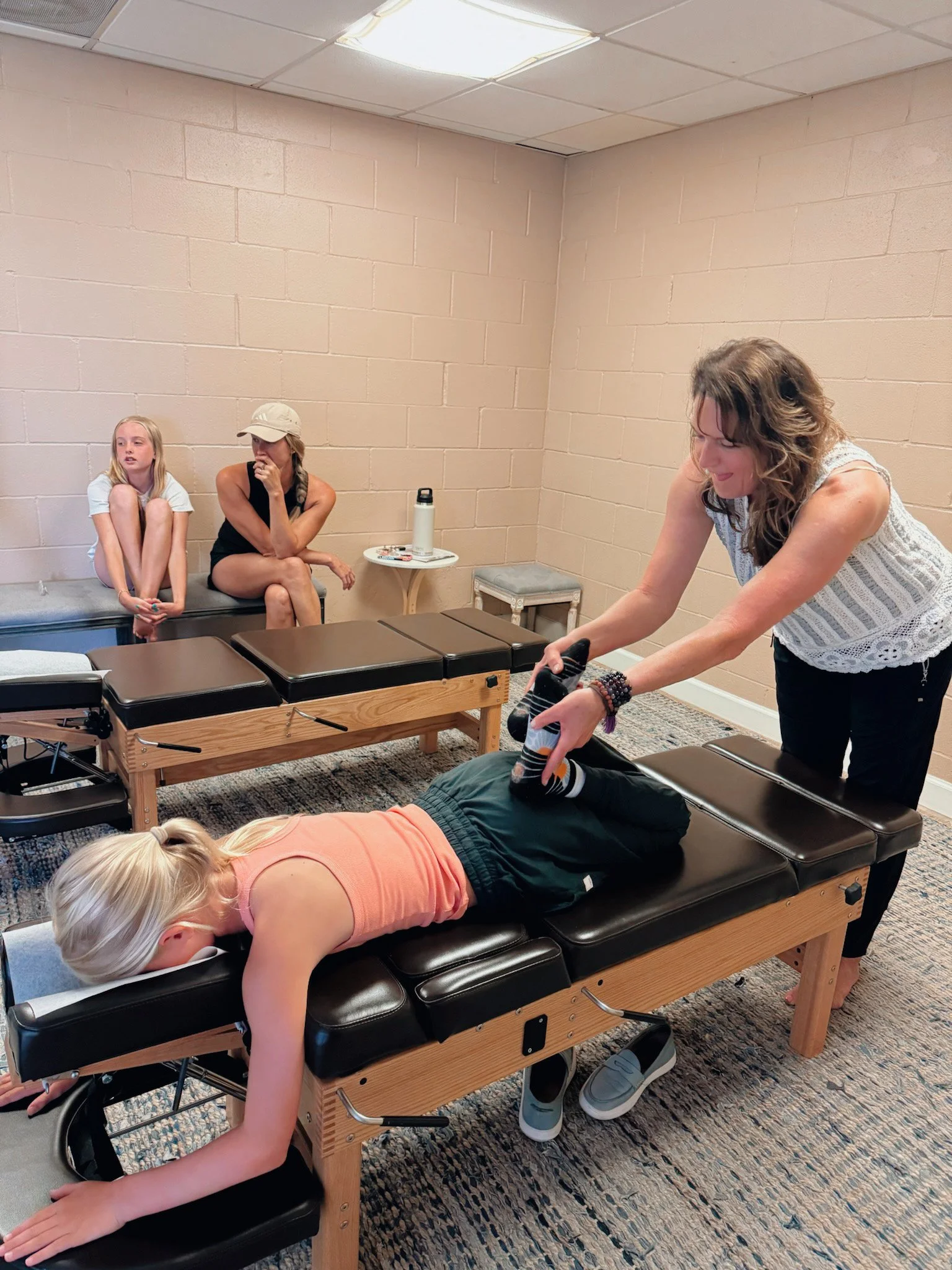
If neurospinal stress and dysregulation are present, Dr. Gina develops an individualized chiropractic care plan based on the patient’s history, examination, and scan findings.
Our adjustments are gentle and specific, with the goal of reducing neurospinal stress and supporting clearer communication and adaptability within the nervous system.
For someone whose system already feels overwhelmed, we aren’t interested in adding more stress.
We want to support the body’s ability to adapt, regulate, and recover.
That care can exist alongside the foundations that matter so much for POTS, including appropriate hydration and electrolytes, quality nutrition, restorative sleep, gradual movement when tolerated, stress support, and guidance from the patient’s medical team.
Your Teen Deserves to Be Heard
Watching a teen or young adult go from thriving to struggling with everyday activities can be incredibly difficult for the entire family.
And while POTS is complex, their symptoms are real.
The racing heart is real.
The dizziness is real.
The exhaustion is real.
The brain fog is real.
Your child deserves a care team willing to look at the whole picture.
If your teen or young adult has been diagnosed with POTS, dysautonomia, or is struggling with symptoms like dizziness, heart-rate changes, fatigue, brain fog, migraines, or difficulty adapting to everyday stressors, a neurological evaluation may provide another useful piece of information.
At Inspire Life Chiropractic in El Cajon, CA, Dr. Gina uses Neurological INSiGHT Scans to better understand patterns of nervous system stress, regulation, and adaptability.
Our goal isn’t to replace your child’s medical care or promise that chiropractic care will resolve POTS.
It’s to help you better understand their nervous system and determine whether neurologically focused chiropractic care could be a supportive part of their overall care plan.
Ready to take a closer look at your child’s nervous system?
Contact Inspire Life Chiropractic to schedule a neurological evaluation and INSiGHT Scans with Dr. Gina. We’d love to help your family understand what the scans are showing and discuss the next steps that may make sense for your child.