
Your Child's 2-Minute Adjustment Is Doing More Than You Think
Most healthcare appointments train us to expect that longer means better.
So when your child's adjustment is over in just a couple of minutes, it's natural to wonder:
"Wait... that's it?"
It's a fair question.
But what if the length of the appointment isn't what determines the impact?
If you've spent years trying therapies, supplements, diet changes, and different approaches, yet still feel like something deeper is missing, you're not alone. Many parents intuitively sense there's a foundational piece that hasn't been addressed yet.
And often, that foundation is the nervous system.
Let's take a closer look at what's actually happening during your child's adjustment and why those two minutes may be doing far more than you realize.
Why the Nervous System Matters So Much
Every function in your child's body is controlled by the nervous system.
Sleep.
Digestion.
Emotional regulation.
Focus.
Immune function.
Motor development.
Sensory processing.
The brain and nervous system coordinate all of it.
When the nervous system becomes overwhelmed by physical, chemical, or emotional stress, communication between the brain and body can become less efficient. This can leave children feeling stuck in patterns of stress, dysregulation, and overwhelm.
That's why, at Inspire Life Chiropractic, we focus on the nervous system first.
Because when the foundation functions better, everything built on top of it has the opportunity to work better too.
A Powerful Example
One of the most remarkable examples of nervous system change was documented in a neonatal intensive care unit (NICU).
A newborn had experienced a difficult birth involving significant stress to the upper neck and brainstem. Because the baby was connected to advanced monitoring equipment, healthcare providers were able to observe changes in real time following gentle chiropractic adjustments.
As care was provided, measurable changes were observed in heart rate, breathing patterns, oxygen levels, and overall tension throughout the baby's body.
While most children aren't connected to hospital monitors during their adjustments, the principle remains the same:
When the nervous system receives the right input, the body has the opportunity to respond.
What a Chiropractic Adjustment Actually Does
Many people assume the adjustment is about the "pop" or "crack."
In reality, that sound is simply gas releasing from a joint and is not what creates the neurological change.
The real purpose of an adjustment is to provide precise input to the nervous system.
Along the spine are thousands of sensory receptors that constantly communicate with the brain. These receptors tell the brain where the body is in space, how much tension is present, and how well movement and coordination are functioning.
A gentle, specific adjustment stimulates these receptors and sends important information back to the brain.
This helps improve communication between the brain and body and supports the nervous system's ability to regulate, adapt, and function more efficiently.
For infants and children, the pressure used is incredibly gentle, often compared to the amount of pressure you would use to check if an avocado is ripe.
Small input.
Big neurological impact.
Why One Small Adjustment Can Affect So Much
Parents often tell us they notice improvements in areas that seem completely unrelated to the spine.
Things like:
Better sleep
Improved digestion
Increased emotional regulation
Greater focus and attention
Fewer sensory challenges
More flexibility when handling stress
Why?
Because the nervous system controls all of those functions.
When the nervous system is constantly operating in a stress response, it can become difficult for the body to shift into a state of healing, recovery, and regulation.
Neurologically-Focused Chiropractic Care helps support the body's ability to move out of that chronic "fight-or-flight" pattern and into a more balanced, adaptable state.
Research has even demonstrated measurable changes in brain function following chiropractic adjustments, including activity within the prefrontal cortex, an area responsible for executive function, attention, and autonomic regulation.
This helps explain why children with very different symptoms can often share a common underlying pattern of nervous system dysregulation.
Why the Adjustment Only Takes Two Minutes
Think of your child's nervous system like a computer with too many tabs open.
Eventually, everything slows down.
Or crashes.
Many children today are already processing an incredible amount of stimulation:
School demands
Screens
Sensory input
Busy schedules
Emotional stress
Physical stress
When a nervous system is already overloaded, more input isn't always better.
In fact, too much input can sometimes create even more overwhelm.
A neurologically-focused adjustment is designed to provide a precise, targeted signal to the nervous system.
The adjustment itself may only take a minute or two.
But the nervous system continues processing and integrating that information for hours and even days afterward.
The adjustment is the stimulus.
The healing happens between visits.
Sometimes less is exactly what the nervous system needs.
Why Frequency Matters More Than Duration
One of the most important concepts parents learn during care is that lasting change comes through repetition.
The nervous system changes through a process called neuroplasticity, which is the brain's ability to create new patterns and adapt over time.
Neuroplastic change doesn't happen because of one long appointment.
It happens because of consistent, repeated input.
Think about it this way:
There are 168 hours in a week.
Your child may spend only a few minutes receiving adjustments.
The rest of the week, their nervous system is responding to growth spurts, school stress, illness, sensory input, sports, screens, and everyday life.
Consistent care helps keep the nervous system moving toward regulation and adaptability instead of continually being pulled back into stress patterns.
Frequency builds the pattern.
The adjustment provides the spark.
How We Measure Nervous System Function
One of the things that makes our approach unique is that we don't rely solely on symptoms.
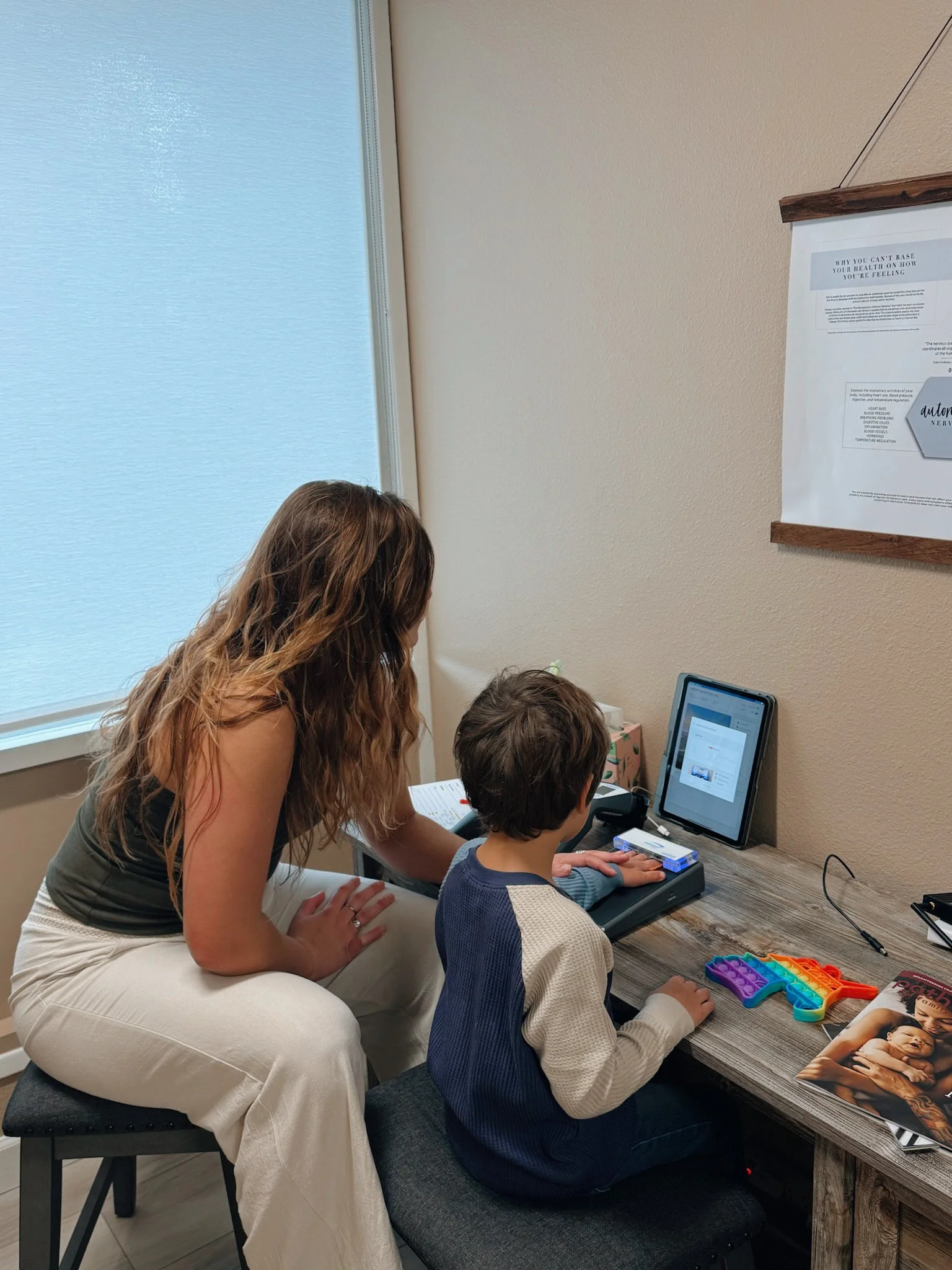
We use advanced technology called INSiGHT Scans to objectively evaluate nervous system function.
Heart Rate Variability (HRV)
HRV measures how well the autonomic nervous system adapts to stress and recovery. It provides valuable insight into vagal tone and nervous system resilience.
Surface EMG (sEMG)
sEMG measures muscle tension and stress patterns along the spine, helping us identify areas where the nervous system may be working harder than it should.
Thermal Scanning
Thermal scans evaluate autonomic nervous system activity along the spine and help identify areas of neurological stress and compensation.
These scans allow us to see patterns that symptoms alone cannot reveal.
Two children with the same diagnosis may have completely different nervous system findings.
That's why we personalize care based on how your child's nervous system is functioning, not simply on a diagnosis or symptom list.
We don't guess. We test.
The Bottom Line
If you've tried therapy after therapy, supplement after supplement, and still feel like something is missing, it may be because the foundation hasn't been fully addressed yet.
The nervous system influences every aspect of your child's health, development, and ability to adapt to stress.
And sometimes, the most important change doesn't come from doing more.
It comes from supporting the system that's responsible for coordinating everything else.
A two-minute adjustment may seem small.
But when it provides the right input to the right place at the right frequency, it can create meaningful changes throughout the body.
Ready to Learn More?
If you're wondering whether nervous system dysregulation may be contributing to your child's challenges, the best place to start is with a Neurological INSiGHT Scan.
These scans help us identify patterns of stress, tension, and dysregulation within the nervous system so we can create a personalized plan of care for your child.
📍 If you're in the San Diego area, our team at Inspire Life Chiropractic would love to help.
📞 Give our office a call or schedule your child's INSiGHT Scan today.
Because when you find the foundation, everything else has the opportunity to build from there.